Fiberglass Rebar Cost vs Steel: Does It Save You Money?
Part 3 of the Concrete Truths: Fiberglass Rebar vs. Steel, Explained series
Most people compare rebar with a simple question: “What does it cost per bar?”
That is a reasonable place to start. It is also where many projects get mispriced, because rebar cost is not only what you pay at checkout. It is what it costs you to move it, cut it, place it, and live with it over the life of the slab or structure.
So when people ask whether fiberglass rebar saves money compared to steel, the honest answer is: it depends on what you count.
If you only count the sticker price, you can miss the bigger story. If you count total installed cost and long-term performance, the comparison becomes much clearer.
Drawing on 30+ years as a leading fiberglass rebar manufacturer, we will use this blog to give you an honest, data-driven cost comparison of fiberglass reinforcement versus steel.
The Fiberglass Rebar vs. Steel Cost Story in Plain Terms
Rebar cost appears in three places that most people recognize immediately once they are named.
- First is the material itself.
Historically, steel often looked cheaper at first glance, and fiberglass rebar was sometimes compared more often to specialty steel solutions. Today, that gap has narrowed in many markets.
In fact, in many regions and common applications, fiberglass rebar can be priced competitively, and in some cases, priced lower than traditional black steel. That matters because it means the savings story may start before you even count labor.
- Second is the work of installation, which is where many projects quietly spend more than expected.
Rebar is not installed on paper. It is unloaded, staged, carried, cut, placed, tied, adjusted, and checked.
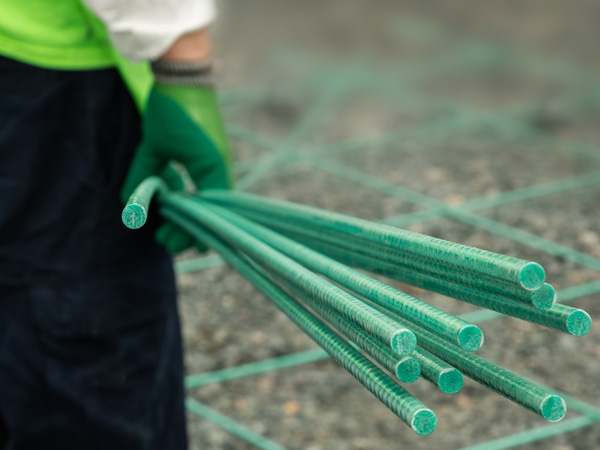
When reinforcement is lighter and easier to handle, crews typically move faster and spend less time moving material and more time installing it. That is why labor often becomes the largest driver of savings, even when the material cost is close.
- Third is logistics and flow, which many people underestimate until they feel it on a job.
Material that requires more trips, more deliveries, and more effort to stage creates an invisible cost.
It adds minutes. It adds fatigue. It adds disruption. Lighter reinforcement reduces that burden.
In many practical scenarios, it can take roughly four full trucks of steel to move the equivalent amount of reinforcement carried in one full truck of GFRP. Exact loads vary by bar size and job conditions, but the directional truth is consistent.
For contractors, the visual is even simpler. Many crews use ladder racks or ladder trucks.
A common benchmark is that you can load up to 500 bars of 10-foot GFRP on a ladder rack, while steel capacity is far lower due to weight. Fewer loads mean fewer trips. Fewer trips means fewer labor hours.
Finally, there is the long-term reality. Steel can corrode. Corrosion can lead to cracking, spalling, and repairs. That is not only a cost issue. It is a disruption issue.
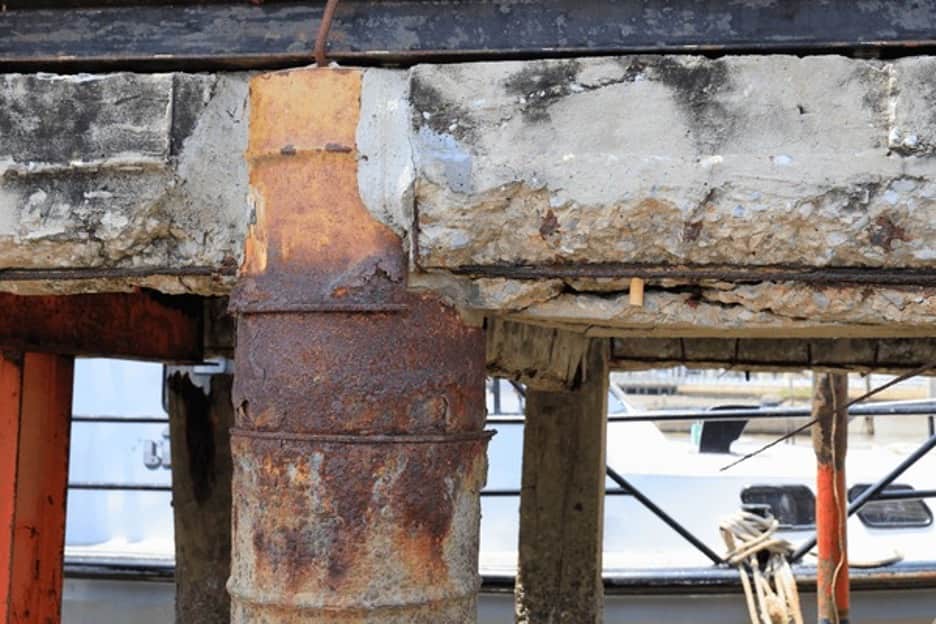
Photo courtesy of Shutterstock.
A corrosion-free reinforcement option reduces corrosion-driven maintenance risk in the reinforced concrete system, which matters to homeowners and DIY builders as much as it matters to infrastructure owners responsible for decades of performance.
When you add those pieces together, the cost story becomes more complete. It is not only “What does a bar cost?” It is “What does the choice cost me to install and live with over time?”
Why the Rebar Cost Comparison Is Even More Compelling Today
There are two additional realities that can further improve the fiberglass rebar cost vs. steel picture.
- One is access. A product is hard to adopt if it is hard to buy. Today, fiberglass rebar is more accessible than ever.
Mateenbar has worked to make fiberglass rebar easier to purchase through the channels people already use, including national availability through Lowe’s across the USA, regional availability through retailers such as Home Depot and White Cap, and a broader network of professional distribution partners such as BlueLinx and others (pictured below).

Access reduces friction. It supports familiarity. It makes it realistic for everyday builders to try fiberglass rebar without special ordering or long lead times.
It is also a reason Mateenbar was recognized with the 2025 ACMA Award for Composites Excellence in the Market Growth category for Greenbar2X®. The award reflects a broader shift happening in the market: corrosion-free reinforcement is becoming more practical for everyday jobs.

- The second reality is the downsizing capability.
In some defined applications, recognized documentation and reviewed equivalency support can allow a smaller fiberglass rebar size to replace a larger steel size when permitted.
For example, a design that uses #4 steel may allow substitution with #3 fiberglass rebar in defined cases.
This concept is supported through recognized documentation such as EER-5548. It is not universal, and it depends on application and design requirements. But when it applies, it can further amplify savings.
Just as important, even when downsizing is not used, fiberglass rebar can still be cost-competitive when you consider the total installed picture.
A Real Example That Pulls It All Together
Now that the cost of fiberglass rebar vs. steel story is clear, it helps to see it through a single project example.
Imagine a 100-foot by 200-foot light commercial slab, such as a warehouse floor, with rebar spacing at 12 inches.
This is where a simple tool becomes useful. Mateenbar created an online Fiberglass Rebar Calculator (pictured below) to help compare steel and fiberglass reinforcement quickly using real-world factors such as bar quantities, weight, handling effort, and estimated placement time.
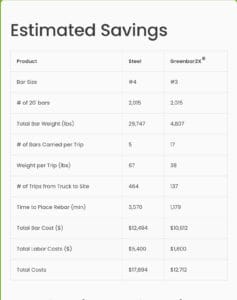
It is designed as a planning tool to help builders understand where savings may come from.
When we run that slab example through the calculator, it produces these totals:
Estimated material savings: $1,582
Estimated labor savings: $3,600
Estimated total savings: $5,182
That equals a 29% total cost reduction in this example, based on a steel total cost of $17,894 versus a fiberglass total cost of $12,712.
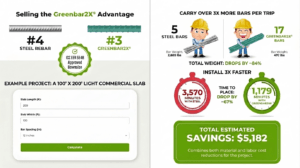
In this example, the story behind the savings is clear.
Total weight drops by about 84%.
Trips from truck to site drop by about 70%.
Time to place drops by about 67%.
Those changes are why labor savings are so meaningful. This is also why the cost story is not only about the material line item. It is about how reinforcement moves through the job.
Why This Matters Across Projects and Users
Cost does not mean the same thing to every project team, but the core drivers are consistent.
Material, labor, logistics, and long-term performance shape the real cost of reinforcement, whether the project is a backyard slab or a major bridge.
For homeowners and DIY builders using flatwork reinforcement like Greenbar2X®, cost often means staying on budget while keeping the project manageable.
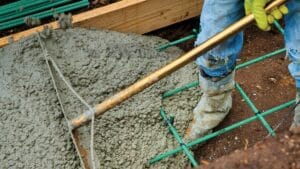
Lightweight reinforcement is easier to carry, stage, and position without specialized equipment, and it reduces the frustration of handling heavy, awkward material.
Corrosion-free reinforcement also helps protect what homeowners care about most: avoiding future cracking, repairs, and premature deterioration that can show up years later when the project is long “finished.”
For contractors, cost is closely tied to pace and predictability. Every extra trip from the truck, every added minute staging material, and every fatigue-driven slowdown shows up as labor hours.
Lighter reinforcement can improve crew efficiency, reduce bottlenecks, and make it easier to keep a pour schedule on track.

There is also a safety reality that affects cost. Lower carry weight and fewer trips can reduce strain-related injuries and fatigue, which helps teams avoid downtime, rework, and productivity loss.
For engineers, architects, and specifiers, cost includes more than installation. It includes credibility, compliance, and long-term performance.
Design professionals want solutions that meet requirements while reducing lifecycle risk, particularly in environments where corrosion is a known threat. That long-term lens is one reason GFRP adoption continues to grow.
For owners and DOT professionals using structural reinforcement like Mateenbar60™, cost is often lifecycle cost.
Repairs are expensive and disruptive. Lane closures and rehabilitation projects impact communities and budgets.
A corrosion-free reinforcement option can reduce deterioration mechanisms that drive maintenance cycles, which can materially change long-term value.
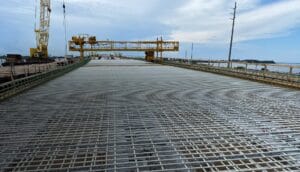
It could potentially help with the durability issues plaguing some of America’s infrastructure, like bridges, where over 220,000 bridges need repair or replacement, according to the 2025 Report Card for America’s Infrastructure on Bridges, released by the American Society of Civil Engineers (ASCE).
When durability improves, the “cost” conversation shifts from the cheapest upfront material to the most resilient outcome over time.
In other words, cost is not just a number. It is time, disruption, risk, and long-term confidence.
The Clearest Way to Think About Fiberglass Rebar vs. Steel Cost
If you only compare rebar by price per bar, you miss the bigger story.
The most useful cost comparison is this: what does this choice cost me to install and live with over time?
Fiberglass rebar can deliver savings in multiple ways:
– competitive pricing in many markets and applications
– labor and logistics savings driven by lightweight handling and faster placement
– corrosion-free durability that can reduce maintenance risk over time
– additional savings in defined applications where the downsizing capability is permitted through recognized documentation
If you are planning a slab, foundation, driveway, or commercial floor, the simplest next step is to compare your own dimensions.
Run your slab size and spacing through the Mateenbar Savings Calculator and use the results as a practical guide for planning and decision-making.
Then ask one strong question before you buy:
“What will this choice cost me to handle, install, and maintain over the life of the project?”
That is the question that separates a line-item decision from a smart project decision.
Fiberglass Rebar Calculator
Fiberglass Rebar vs Steel comparison page
That wraps up our Concrete Truths series. If you have questions about your application or want help interpreting the calculator results, our team is here to support you with clear guidance and practical next steps.
If you missed the first two blogs in our Concrete Truths: Fiberglass Rebar vs. Steel, Explained series, see the links below: