Is Fiberglass Rebar as Strong as Steel? The Truth
Part 2 of the Concrete Truths: Fiberglass Rebar vs. Steel, Explained series
In the first article of this series, we compared fiberglass rebar (GFRP) and steel through the lens of weight, corrosion resistance, standards, and quality.
The most common follow-up question is straightforward: Is fiberglass rebar as strong as steel?
In that first blog, we noted a reality that often surprises people. In terms of tensile strength, fiberglass rebar is often at least two times stronger than steel, depending on the product and bar size.
That statement needs context. It refers to tensile strength, not stiffness. It also does not capture the full strength story, because the strength in reinforced concrete is not one number.
Tensile strength matters, but behavior under load, service performance, and durability over time matter too.
In this blog, we at Mateenbar will use our over 30 years of experience as a GFRP manufacturer to explain what “strong” really means in concrete reinforcement, and how GFRP and steel compare in the ways that actually influence design decisions and long-term performance.
With a clearer understanding of GFRP properties and design pathways, it becomes easier to see why GFRP is increasingly viewed as a credible alternative to steel in many applications.
What “Strong” Really Means in Reinforced Concrete
Strength in reinforced concrete is not only about the rebar. It is about how a reinforced concrete component in a real project performs as a system, whether that is a slab, footing, wall, or bridge deck.
A clear way to think about strength is through three connected questions:
Capacity
How much force can the reinforcement carry in tension?
Behavior
How does the reinforcement respond as loads increase, and how does that affect the design approach?
Performance over time
How does the structure perform in service, including cracking, deflection, and durability across years of exposure?
Steel and GFRP can both be designed successfully, but they deliver strength differently.
That is why the right comparison is not “is fiberglass rebar stronger than steel,” but “strong in what way, under what design approach, and over what service life.”
Capacity: Fiberglass Rebar Tensile Strength and What It Means Compared to Steel
Tensile strength is the maximum stress a bar can carry in tension before failure. It is one of the easiest strength values to understand, and it is also one of the clearest points of differentiation between GFRP and steel.
Steel reinforcement is commonly specified by yield strength, such as the familiar Grade 60 conversation. That yield behavior is part of why steel has been trusted for decades. It performs predictably within established design methods.
GFRP is different. It does not yield in the same way as steel, so design provisions treat its strength differently.
At the same time, published tensile values for GFRP can be very high, which is why tensile strength often becomes the first point people notice.
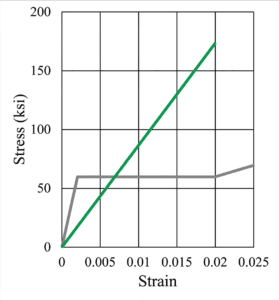
The graph below illustrates the fundamental mechanical difference between the two materials: steel (grey) exhibits a classic elastic-plastic response, rising steeply before yielding near 60 ksi and then deforming with little additional stress, while fiberglass rebar (green) climbs linearly all the way to rupture, reaching tensile strengths well above 150 ksi with no yield plateau.
To keep this grounded in publicly published information, consider the guaranteed ultimate GFRP rebar tensile strength examples shown in Mateenbar brochures.
Greenbar2X® examples:
#4: 745 MPa (108 ksi)
#3: 830 MPa (120 ksi)

Mateenbar60™ examples:
#4: 961 MPa (139.5 ksi)
#3: 1000 MPa (145.5 ksi)
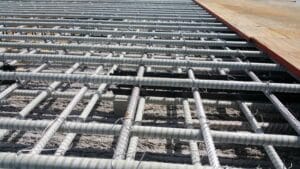
These values help illustrate why GFRP tensile capacity is taken seriously by engineers and specifiers. Steel remains the benchmark material in concrete reinforcement largely because it is familiar, widely understood, and backed by decades of design practice.
That said, when the conversation turns specifically to tensile capacity, GFRP can compare very favorably.
The takeaway is that tensile strength is a meaningful part of the comparison, and it must be evaluated alongside behavior under load and how the structure performs in service. That is where real-world performance differences emerge.
That is why tensile strength is only one part of the strength story.
See the video below for how Greenbar2X® performs under a tensile strength test:
Bond and System Capacity Considerations
Rebar strength only becomes meaningful when the concrete and reinforcement act together as a system. That system performance depends on bond, development, and detailing.
Bond is how effectively the bar grips the concrete, so loads transfer properly between the two materials.
Detailing refers to reinforcement layout and key design choices that make the system work as intended, including bar spacing, lap splices, concrete cover, and how reinforcement is placed within the concrete component.
Steel has a long-established history of bond behavior and detailing practices. GFRP has also been tested extensively, and requirements exist that define how it must perform in concrete.
This is why test methods were developed to ensure the bond strength of GFRP reinforcing bars is sufficient to develop this composite behavior, ASTM Standard Test Method D7913. In fact, both ASTM D7957 and ASTM D8505 list minimum bond requirements accordingly.
Mateenbar® brochures include bond-related statements aligned with those requirements:
- Greenbar2X® bond strength exceeds ASTM D7957 requirements
- Mateenbar60™ bond strength exceeds ASTM D7957 and ASTM D8505 requirements
The practical takeaway is this: strength is not only a tensile value. It is also whether the bar develops properly, interacts predictably with concrete, and is designed and detailed using the applicable provisions.
This is one reason product documentation matters. When a manufacturer provides clear test-backed specifications and code pathways, it supports confidence that the reinforcement system will perform as intended in the field.
Mateenbar® establishes that confidence through consistent documentation and traceability, including clear identification and printed information on each bar to help crews and project teams verify what is being installed.
Behavior Under Load: Why Steel and GFRP Are Designed Differently
Steel and GFRP behave differently as loads increase.
As mentioned above, steel yields. In practical terms, it can stretch or deform more before failure. That yielding behavior is a foundational part of how steel-reinforced concrete has been designed for decades.
GFRP behaves differently. It does not yield the same way. This difference is not a flaw. It simply means the design approach must match the material, and the material must be used within the appropriate design provisions.
Behavior also includes stiffness, which influences how reinforced concrete responds under load in service.
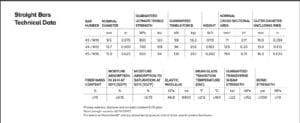
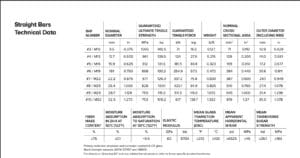
Mateenbar® brochures list elastic modulus values as:
- Greenbar2X®: 46.8 GPa (6800 ksi)
- Mateenbar60™: 60 GPa (8700 ksi)
See below for Greenbar2X®’s Data Sheet:
See below Mateenbar60™’s Data Sheet:
Steel is significantly stiffer than both GFRP products, which is one reason steel-reinforced components can behave differently in service, particularly around deflection and crack width.
This does not make one system automatically “better.” It reinforces why strength must be evaluated through the correct design provisions for each material.
The point is not to turn this into a stiffness lesson. The point is to highlight a practical reality. Strength is about how the reinforced concrete component performs, not only the maximum force a bar can take in a test. That is why engineers design for service performance and why the design framework matters.
This is where many comparisons go off track. If the question becomes “does it behave exactly like steel,” the decision often gets framed incorrectly.
A more useful question is: can this material be designed with confidence, using established provisions that account for how it behaves in reinforced concrete?
That is exactly why codes and standards exist. The industry does not rely on guesswork for steel, and it does not rely on guesswork for GFRP.
Proper design frameworks are what allow different materials to be used safely, repeatably, and predictably.
Performance in Concrete: Strong in Service, Not Only Strong on Paper
A reinforcement material can have impressive tensile capacity, but projects succeed based on service performance, that means how the reinforced concrete structure behaves and holds up under normal use, day after day, season after season.
For a slab, it can mean controlling cracking and maintaining expected performance under traffic and loads.
For a bridge component, it can mean long-term durability, predictable behavior, and reduced deterioration mechanisms over decades.
In practical terms, service performance includes:
- how cracks form and are controlled
- how the structure behaves over time under real conditions
Strength Over Time: Durability and Long-Term Performance
Durability is part of long-term structural performance. Steel reinforcement is susceptible to corrosion in many environments, which can affect service life and maintenance requirements over time.
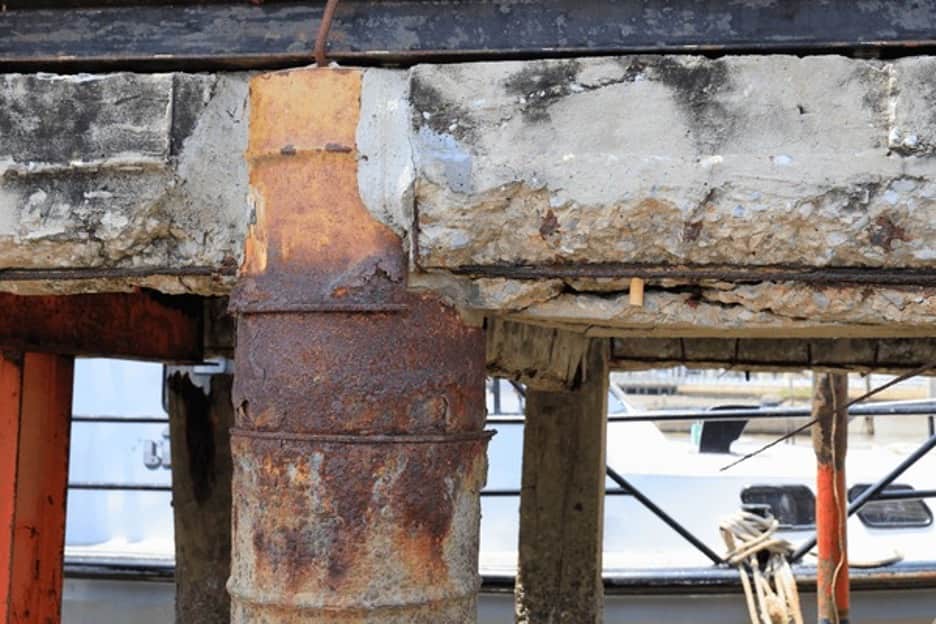
Photo courtesy of Shutterstock.
GFRP does not rust, which removes corrosion as a key deterioration mechanism in the reinforced concrete system.
We cover corrosion resistance and durability in more depth in Blog #1 of this series, including why this issue matters across North America and how it affects lifecycle outcomes.
Codes and Standards: A Brief Reminder
Codes, standards, and evaluation pathways are what turn material properties into design confidence and repeatable practice. We cover the broader standards and approvals ecosystem in Blog #1, including the role of ASTM, ACI, ICC-ES, and related frameworks.
Connecting Back to Blog #1: Evaluation Pathways and the Downsizing Conversation
This connection matters because evaluation pathways help translate material properties into practical design confidence, and the following project examples show how that plays out in common applications.
In Blog #1, we discussed evaluation pathways and how, in defined applications, these pathways can support substitution decisions, including the well-known downsizing conversation from #4 steel to #3 GFRP.
This belongs in a strength discussion for a simple reason. Substitution and downsizing are not casual shortcuts. They only exist when performance has been evaluated within recognized frameworks that consider capacity, behavior, and codified design methods.
It is a practical example of how strength, design provisions, and evaluation pathways intersect.
Two Practical Examples: One Light Commercial, One Infrastructure
Greenbar2X® example: a 100-foot by 200-foot warehouse slab
Imagine a 100-foot by 200-foot warehouse slab where reinforcement must be staged efficiently, installed consistently, and perform reliably under traffic and service loads. In these jobs, the strength question is rarely abstract. Teams want confidence that the reinforcement is accepted, designed correctly, and predictable once it is in the concrete. Greenbar2X® is designed for residential and light commercial applications and is supported by published specifications and code-based evaluation pathways. Its tensile strength characteristics help support design confidence.
Mateenbar60™ example: a bridge deck or barrier element
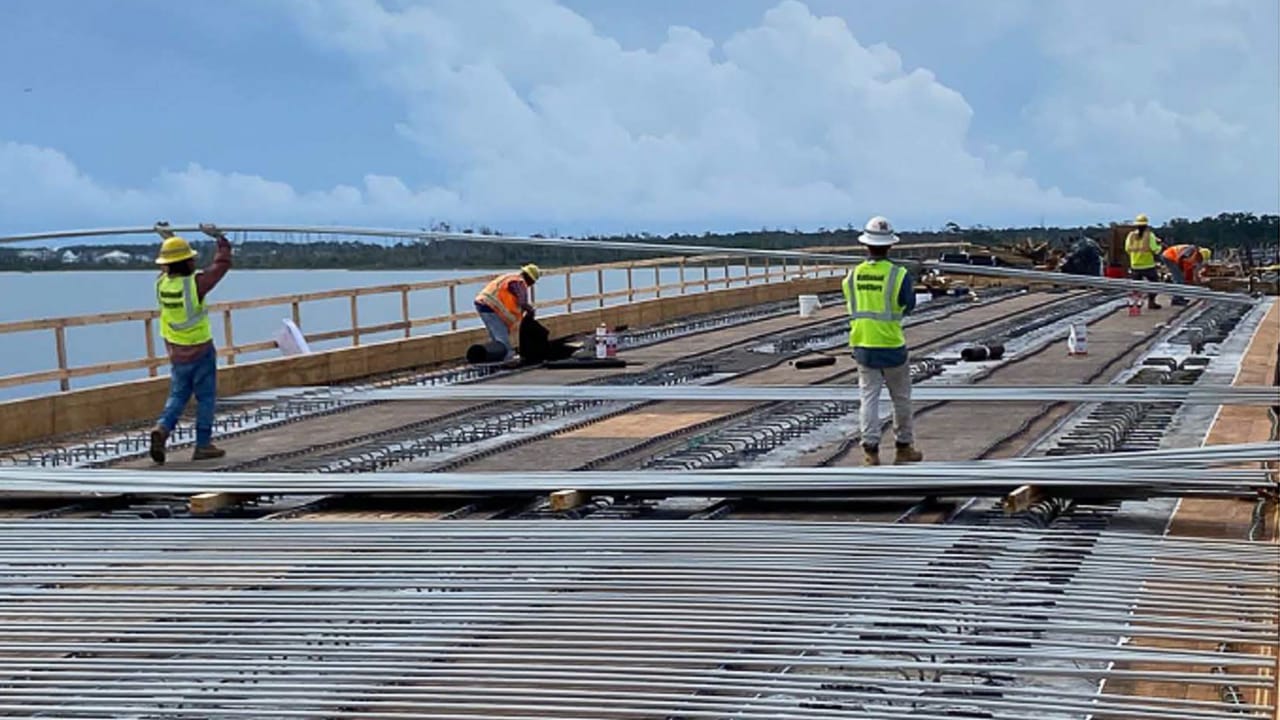
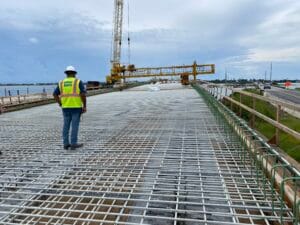
Now consider a bridge deck where a long design life is expected and maintenance disruptions carry real public cost. Here, “strong” must be evaluated through multiple lenses: initial capacity, behavior under load, service performance, and durability in harsh exposures. Mateenbar60™ is positioned for structural and infrastructure applications such as bridge decks, seawalls, piles, and coastal structures. In these environments, strength and durability are inseparable, and code-based design confidence matters. For federally funded work, domestic manufacturing and Build America, Buy America compliance can also support procurement confidence and long-term accountability. Mateenbar60™ has been used in notable U.S. bridge projects, including the Harkers Island Bridge in North Carolina (see below), which is the world’s longest bridge built entirely without steel reinforcement.
Comparison Table: Strength in Context
| Criteria | Steel Rebar | Fiberglass Rebar (GFRP) | Why It Matters to You |
|---|---|---|---|
| Tensile capacity | Strong and familiar | Often very high tensile capacity (varies by product and bar size) | Tensile strength can be significantly higher, but it must be evaluated correctly |
| Behavior under load | Yields | Different behavior, does not yield the same way | Requires a design approach aligned to the material’s behavior |
| Service performance | Familiar assumptions | Serviceability designed differently | Strength includes crack control and deflection, not only ultimate capacity |
| Bond and system action | Established | Must meet defined requirements | Strength matters only if the bar develops properly and works with the concrete |
| Durability over time | Corrosion can reduce long-term performance | Corrosion-free | Strength that lasts, especially in harsh exposures |
| Standards and pathway | Long-established | Supported by ASTM, ACI, ICC-ES, and applicable masonry standards | Specifiable through documented, repeatable frameworks |
The Real Answer to “Is Fiberglass Rebar as Strong as Steel?”
Fiberglass rebar can be extremely strong in tensile terms, often at least two times stronger than steel, depending on the product and bar size. But the strength conversation is bigger than tensile capacity.
Strength in reinforced concrete depends on capacity, behavior, and long-term performance in service.
Steel and fiberglass rebar behave differently, and that is why design provisions exist and why standards matter.
When evaluated and used properly within code-based approvals, fiberglass rebar is a dependable reinforcement option for teams assessing durability, constructability, and long-term performance.
Mateenbar® has over 30 years of fiberglass reinforcement experience with products used globally and across the United States.
That track record supports the long-term performance expectations that engineers, contractors, and owners rely on when they choose materials intended to last.
To go deeper, visit our fiberglass rebar vs steel comparison page.
Up next in the Concrete Truths series:
Fiberglass Rebar Cost vs Steel: Does It Save You Money?
That is where we will address how cost is evaluated across installation, transport, lifecycle maintenance, and long-term value.