

See the Real Savings Behind Greenbar2X®
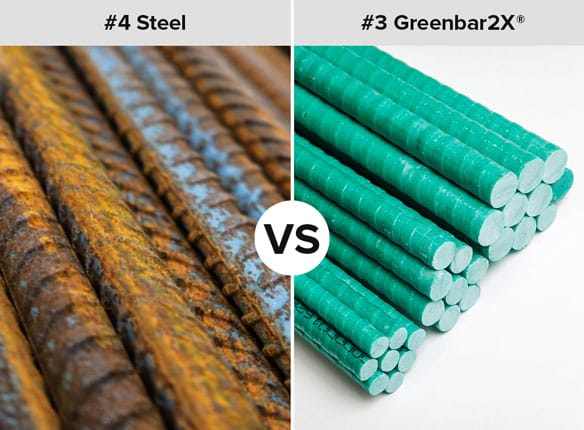
Contractors don’t have time for guesswork. We built this rebar calculator tool to put clear numbers behind a decision many pros are already considering: moving from #4 steel to #3 Greenbar2X® in many residential slab applications permitted by ICC EER-5548. Use it to estimate materials and labor costs side-by-side. Cost savings will justify the switch, protect your margin, and keep jobs moving without added approvals or delays.
This isn’t marketing fluff. It’s a quick way to sanity: check your layout, see where the savings come from (material quantity, handling, and install time), and bring a simple, credible comparison to your customer, GC, or inspector. Because the comparison downsizes from #4 steel to #3 Greenbar2X®, the Greenbar2X® column will show the cost advantage. This online rebar calculator tool simply puts a number to it.
How It Works

Slab Dimensions
Enter your slab length and width (feet)

Bar Spacing
Choose your bar spacing
Results
Compare results: #4 Steel vs #3 Greenbar2X®
Savings Calculator
Estimated Savings
| Product | Steel | Greenbar2X® |
|---|---|---|
| Bar Size | #3 | #3 |
| # of 20' bars | 0 | 0 |
| Total Bar Weight (lbs) | 0 | 0 |
| # of Bars Carried per Trip | 0 | 0 |
| Weight per Trip (lbs) | 0 | 0 |
| # of Trips from Truck to Site | 0 | 0 |
| Time to Place Rebar (min) | 0 | |
| Total Bar Cost ($) | $0 | $0 |
| Total Labor Costs ($) | $0 | $0 |
| Total Costs | $0 | $0 |
Total Estimated Savings
| Savings | Amount |
|---|---|
| Estimated Material Savings ($) | $0 |
| Estimated Labor Savings ($) | $0 |
| Estimated Total Savings ($) | $0 |
Why Contractors Use This Rebar Calculator Tool
- Fast, practical math: On the phone, on site, or at the desk.
- Budget clarity: See where savings add up across materials and labor.
- Code-aligned guidance: Based on ICC EER-5548 recognizing #3 Greenbar2X® as a #4 steel alternative in many residential applications.
- Plan with confidence: Lighter bars and easier handling can help crews work faster with less strain.
Tip: Try multiple spacing options (10″, 12″, etc) to see how layout choices impact savings.
Notes & Assumptions
This tool provides an estimate for typical residential flatwork. It isn’t a stamped design or a formal bid. Always follow project plans, local building codes, and engineer/authority guidance. For structural or non-residential work outside residential scope, contact Mateenbar for engineering support.
Prices may vary by market. Check with your local supplier for current prices in your area.
How Many Bars Can a Worker Carry with GFRP Versus Steel?
Because Mateenbar® GFRP weighs significantly less than steel, workers can comfortably carry several bars at a time rather than struggling with one or two heavy steel lengths.
For example, a 20’ x 20’ section with 12” spacing requires 42 bars. With GFRP, you can carry around 17 bars per trip instead of only 5 with steel, according to our Fiberglass Rebar Calculator—cutting the number of trips from the truck by more than half.
This significantly improves productivity and reduces worker fatigue. The lighter weight also makes staging and layout much faster.
What Is the Time Savings for GFRP Installation Versus Steel?
Most projects experience faster installation when switching from steel to GFRP due to lighter handling and easier cutting. Crews spend less time tying, moving, and positioning bars.
According to our calculator, a project requiring 42 bars for a 20’ x 20’ section with 12” would take an estimated 25 minutes using GFRP compared to 75 minutes using steel.
These efficiencies scale dramatically on large infrastructure projects.
What Are the Estimated Cost Savings for GFRP Versus Steel?
While steel prices fluctuate, GFRP often delivers total project savings through reduced labor, faster placement, and lower logistic costs.
You also eliminate long-term expenses tied to corrosion repair, maintenance, and life-cycle degradation.
For many applications—especially in harsh or coastal environments—the lifetime cost of GFRP can be significantly lower than steel.
To see this in practice, our Fiberglass Rebar Calculator shows that using GFRP on a project requiring 42 bars for a 20’ x 20’ section with 12” spacing can yield around $115 in total savings when factoring in both material and labor.
How Do I Calculate How Much Rebar I Need?
To estimate the amount of rebar needed, review your project’s structural drawings, which specify bar sizes, spacing, and layout requirements.
From there, calculate the total linear footage by measuring each segment where reinforcement is required.
If you’re using GFRP, or fiberglass rebar, like Mateenbar®, our calculator automates this process so you can quickly estimate quantities for ordering.
How Do I Calculate Rebar in a Concrete Slab?
For a slab, determine the grid layout by using the specified spacing in both directions (for example, 12″ x 12″).
Multiply the number of bars required along the length and width, then convert to total bar length based on your slab dimensions.
Don’t forget to include laps and edge conditions. With GFRP, lighter bars and customizable lengths make it easier to plan a more efficient layout.
How Do I Calculate Rebar Per Square Foot?
Rebar per square foot is derived from the spacing of your reinforcement grid.
Divide 12 inches by the bar spacing in each direction to determine bars per linear foot, then convert that into total length per square foot.
This helps estimate material usage for large slabs or mats. With GFRP’s lighter weight and ability to ship in custom lengths, projects often see reduced waste compared to steel rebar.
How Do I Calculate Rebar Spacing?
Spacing is determined by engineering requirements based on loads, slab thickness, and code guidelines.
The project designer will specify exact spacing, but you can calculate it by dividing the width or length of the area by the number of bars required in the grid.
Proper spacing ensures balanced load distribution and minimizes cracking.
How Do I Calculate Rebar Weight?
Steel rebar weight is calculated using standard unit weights based on bar diameter, then multiplying by total length.
GFRP bars are different—they weigh about one-quarter of steel—so the weight calculation is much lighter and easier to manage on-site.
This reduction improves logistics, reduces handling costs, and lowers the physical strain on workers.
Our calculator provides an instant comparison between the weight of #4 steel rebar and #3 Greenbar2X® GFRP.