Fiberglass Rebar vs. Steel: Rethinking the Default
Steel has been the default reinforcement choice for generations. It is familiar, widely available, and deeply woven into how the industry builds.
But the “default” is not always the “best fit.” That is why more contractors, engineers, and DOT professionals are taking a closer look at fiberglass rebar (GFRP).
This blog is written for the full spectrum of construction decision-makers:
- Contractors thinking about jobsite productivity.
- Engineers evaluating design confidence.
- Specifiers balancing performance and risk.
- DOT professionals focused on lifecycle outcomes and long-term public value.
Our goal is to use our over 30 years of expertise as a fiberglass rebar manufacturer to present a practical comparison between GFRP and steel that helps you make smarter reinforcement decisions.
Not based on hype and not based on habit. Based on what matters on real projects: handling, durability, standards, long-term performance, and material integrity.
This is Part 1 of our Concrete Truths: Fiberglass Rebar vs. Steel, Explained Series, where we will cover weight comparisons, corrosion resistance, standards/codes and quality. We will go deeper on strength and cost in the next part of this blog series.
Fiberglass Rebar vs. Steel: Weight and Handling
If you want an instant, jobsite-level difference between steel and fiberglass rebar, start with weight.
A standard #4 steel rebar weighs about 13.36 lbs for a 20-foot bar. Anyone who has carried bundles of steel rebar understands what that means over the course of a day. Unloading, staging, carrying, tying, adjusting, repositioning, and repeating.
Now consider a typical GFRP fiberglass reinforcing bar of the same length, which can weigh just 3.66 pounds.
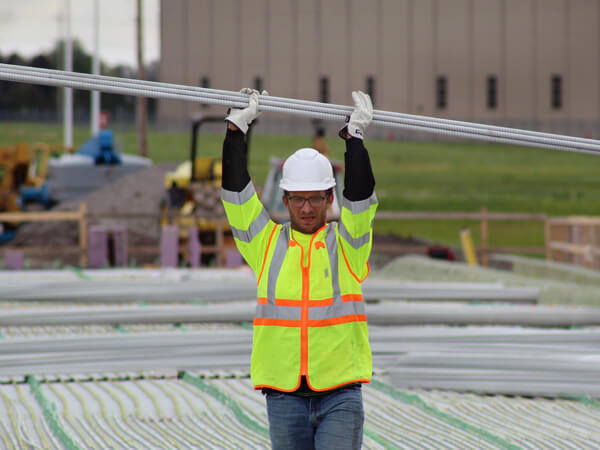
That single change shifts the physical reality of reinforcement work. The material moves differently through the project.
That difference in weight shows up in ways crews and project managers immediately recognize:
- Handling and placement become easier, especially when rebar must be carried across a site or lifted repeatedly into position.
- Staging becomes simpler because crews can reposition material with less equipment and less effort.
- Cutting is faster and easier, allowing crews to size bars on-site without torches, heavy saws, or added safety controls.
- Productivity improves when the material itself stops being a constraint on speed and fatigue.
- Safety improves because lighter lifting reduces strain across repetitive work.
Weight is not just convenience. Weight affects crew fatigue, pace, safety, and the ability to keep a concrete pour or schedule on track.
Where the Fiberglass Rebar vs. Steel Comparison Gets Even More Interesting
For many project teams, the bigger story is not only that fiberglass rebar is lighter than steel.
It is that verified testing and code evaluation can enable direct steel substitution in specific applications, including the well-known downsizing conversation when permitted.
This is where equivalency reports matter. With an ICC-ES equivalency report such as EER-5548, products like Mateenbar’s® Greenbar2X® can support direct substitution pathways that help engineers and contractors simplify decisions and avoid added approval steps.
When downsizing from #4 steel to #3 GFRP is allowed, the difference becomes dramatic. In this comparison, a 20-foot #3 Greenbar2X® GFRP bar is about 2.2 lbs, according to our Fiberglass Rebar Calculator.
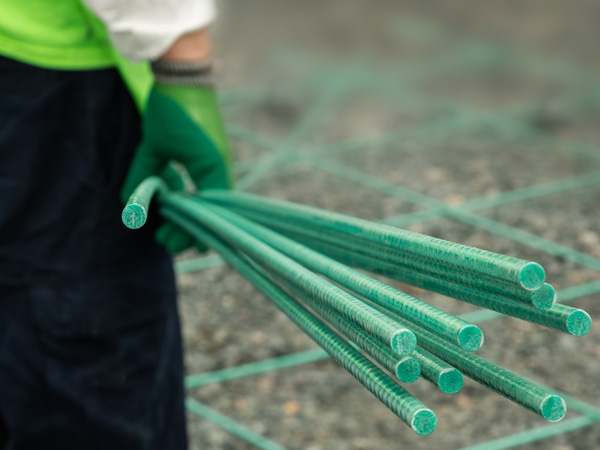
That means:
- #4 steel at ~13.36 lbs vs #3 GFRP at ~2.2 lbs is about 84% lighter per bar
This is where weight stops being a talking point and becomes a logistics advantage:
- 500 bars on one ladder rack
- Smaller crews, fewer labor hours
- Reduced fuel and transport costs
- 1 truckload of GFRP can equal about 3.5 truckloads of steel
Those are not abstract benefits. They show up in procurement, delivery planning, jobsite staging, and the day-to-day efficiency of a crew placing concrete.
Corrosion Resistance: Where Durability Becomes the Whole Story
Steel reinforcement is susceptible to corrosion in many environments.
When corrosion occurs, the resulting expansion can cause concrete cracking and spalling, which may increase maintenance requirements and affect the long-term service life.
This is especially the case regarding America’s bridges, which scored a “C” on last year’s Report Card for America’s Infrastructure, conducted by the American Society of Civil Engineers (ASCE).
They found that over 220,000 bridges (most of which use steel reinforcement in the concrete elements) need repair or replacement, with corrosion and maintenance-related degradation being the primary causes.
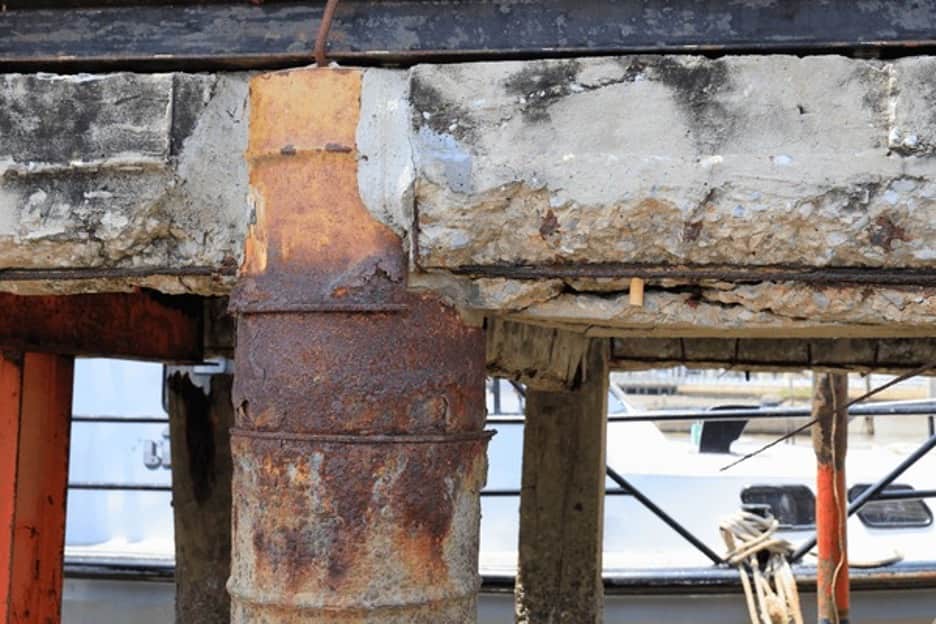
Photo courtesy of Shutterstock.
Fiberglass rebar does not rust. That difference has cascading implications for every stakeholder.
- For DOTs and owners, corrosion is rarely a small issue. It drives major rehabilitation cycles, lane closures, disruption to communities, and long-term capital planning.
- For engineers and specifiers, corrosion affects durability assumptions and service life expectations.
- For contractors and builders, corrosion-driven deterioration can lead to callbacks, repairs, and reputational risk.
The key point is that corrosion is not only a coastal problem. Chlorides, moisture conditions, freeze-thaw cycles, and de-icing salts show up across North America.
In many regions, the corrosion clock starts earlier than people expect. Often, when purchasing steel directly from distribution or retail partners, it has already started to corrode, meaning you’re purchasing a new product off the shelf that has already started to be compromised.
This is why service life comparisons matter.
Many professionals reference up to 100 years for fiberglass rebar systems versus 40 to 50 years for steel rebar in many conditions.
The exact number depends on the environment and design, but the direction is clear. A non-corroding reinforcement changes the durability equation on a fundamental level.
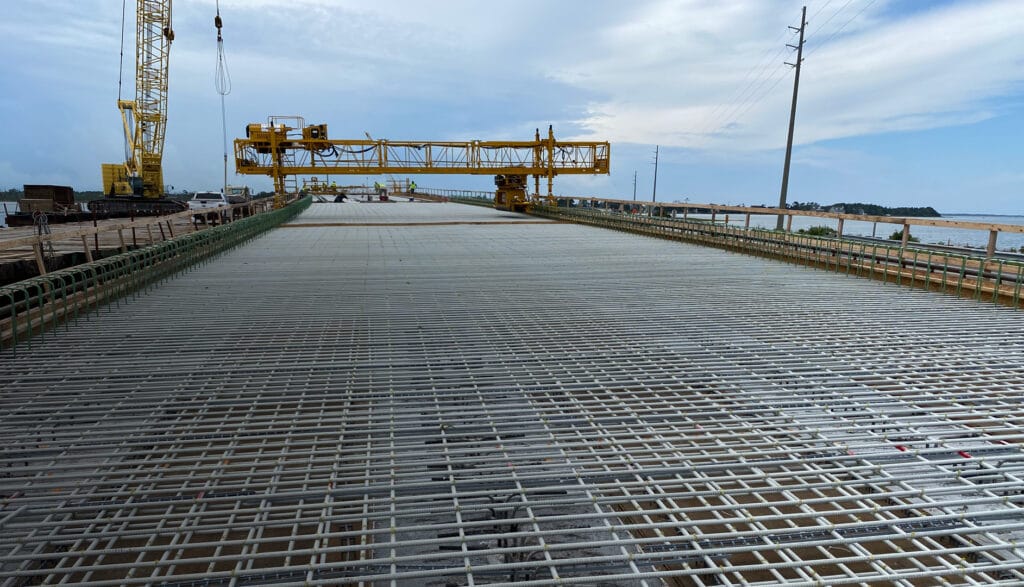
Strength: Not the Same Behavior, But a Bigger Conversation Than Most People Realize
A lot of people reduce the question to a soundbite: “Is fibgerlass rebar as strong as steel?” That question is understandable, but it is also incomplete.
Steel and fiberglass rebar behave differently under load. Steel yields. Fiberglass rebar does not. Stiffness, crack control, and design methods are not identical.
Here is the hook worth paying attention to. In terms of tensile strength, fiberglass rebar is often at least two times stronger than steel, depending on the product and bar size. That surprises many people, especially those who assume heavier automatically means stronger.
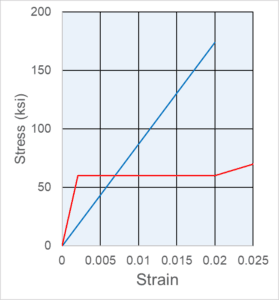
The material is not “trying to become steel.” It is engineered as a different reinforcement solution with different advantages, including corrosion resistance and high tensile performance.
The real question is not whether fiberglass rebar is viable. It is whether you are evaluating it using the right lens, including the factors that matter in reinforced concrete design.
Tensile strength is only one part of the strength story, and we will explain why in Part 2.
Blog #2 will unpack this in a practical way, including a deeper dive into strength comparisons, what the numbers really mean, and what engineers should actually be measuring and designing for.
Standards and Codes: How Fiberglass Rebar Earned Design Confidence
One reason steel remains the default is that it is backed by a long-established standards ecosystem. The industry values predictability, repeatability, and design rules that can be specified with confidence.
Fiberglass rebar has followed a disciplined path toward broader acceptance through testing, research, performance history, and industry collaboration.
It required engineers, standards developing bodies, and technical advocates to do the hard work of translating material science into clear design methods and specification pathways.
That work matters because it helps ensure fiberglass rebar is evaluated using documented requirements and code-based design guidance rather than assumptions.
Today, fiberglass reinforcement is supported by a broad framework of standards and approvals, including:
- ASTM standards governing GFRP reinforcing bar requirements and performance criteria
- ACI guidance and code language for GFRP reinforced concrete design
- ICC-ES evaluation reports that support code-based use and substitution pathways
- TMS masonry standards, where applicable, for reinforced masonry systems
- Application-specific acceptance pathways that engineers and jurisdictions rely on for consistent specification

When a material category is recognized across multiple code bodies and standards organizations, it signals something important.
It means design acceptance is grounded in documented performance and repeatable requirements. It also means the industry has created pathways for proper use, not guesswork.
This is one of the reasons many professionals are increasingly comfortable specifying fiberglass rebar. The standards are there, the design provisions exist, and the material is evaluated as a codified reinforcement solution.
Quality and Traceability: The Part of the Conversation That Separates Products
At this point, many professionals accept that “fiberglass rebar” is a category with real advantages.
The next important set of questions becomes: what kind of fiberglass rebar, made where, under what controls, and backed by what documentation?
That is where quality and traceability become critical. In any market, products can look similar while differing in consistency, documentation, and manufacturing controls.
And in a category that has attracted global attention, supply can come from many sources. The reality is simple.
The easier it is to verify a manufacturer’s processes, controls, and documentation, the easier it is to trust the material you are putting into your concrete structures.
This is where domestic manufacturing often becomes a practical advantage. Companies that manufacture in the United States, with visible facilities and controlled processes, are typically easier for owners, engineers, and contractors to evaluate for:
- process consistency and quality controls
- documentation and traceability
- availability and continuity of supply
- long-term technical and engineering support
Imported materials can absolutely play a role in the market, but they can also introduce variability in documentation and verification. For project teams looking to reduce risk, a “material choice” is also a “verification choice.”
Manufacturers like Mateenbar®, a U.S. company with manufacturing in Concord, North Carolina, contribute to domestic jobs and supply chains.
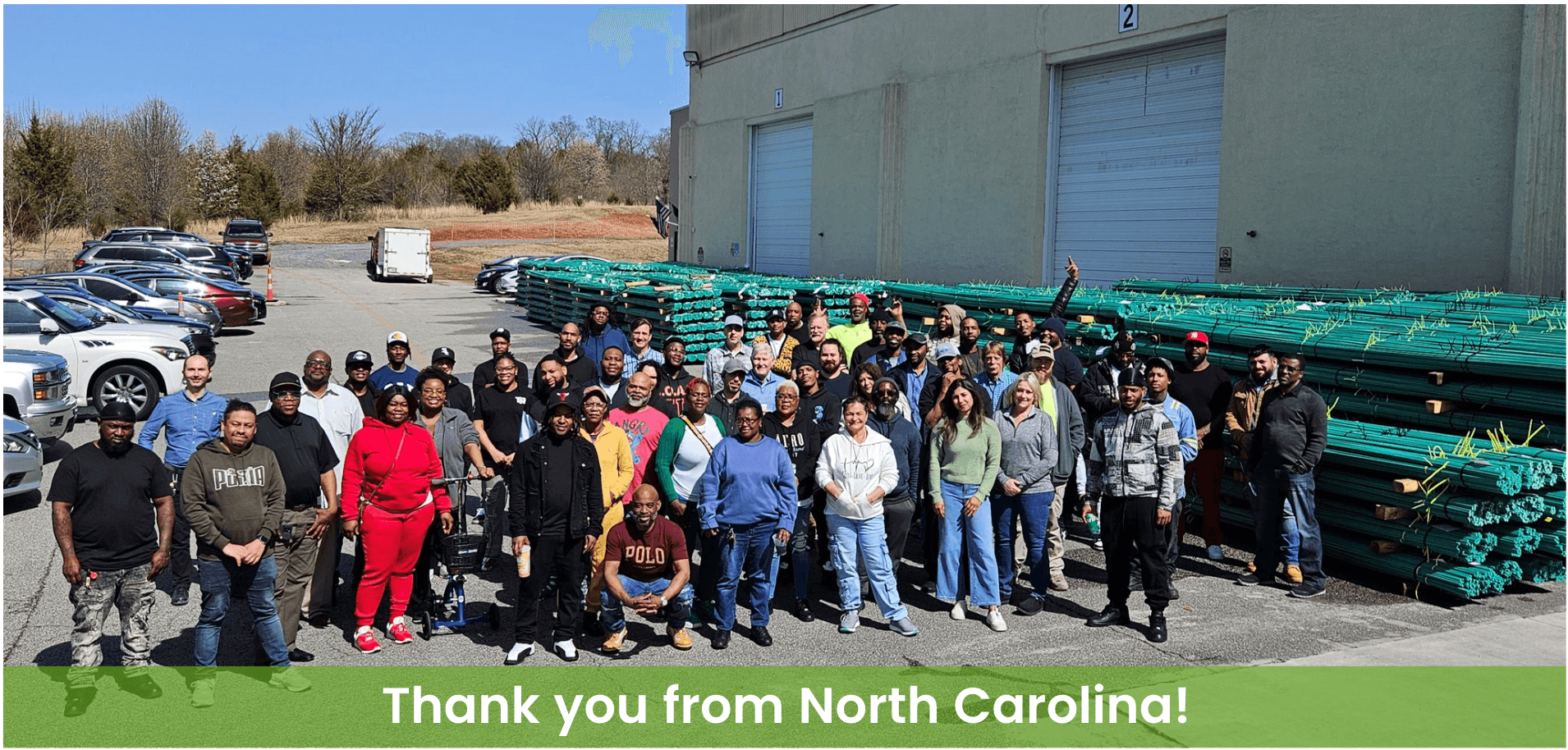
For public infrastructure work, domestic manufacturing also supports a critical requirement in many projects: Build America, Buy America (BABA) compliance.
For government contractors and DOT federally funded work, that is not a marketing point. It is peace of mind that the material aligns with funding requirements and procurement expectations.
Reinforcement decisions are not only material decisions. They are quality decisions, documentation decisions, and long-term support decisions.
Quick Comparison Snapshot
| Criteria | Steel Rebar | Fiberglass Rebar (GFRP) | Why It Matters to You |
|---|---|---|---|
| Weight (#4, 20 ft) | 13.36 lbs | Typical GFRP can be just over 3.66 lbs | Faster handling, less fatigue, easier staging |
| Corrosion | Highly susceptible | Corrosion-free | Fewer durability failures tied to rust and spalling |
| Transport and staging | Heavier loads, more trips | Higher bars-per-load potential | Eased logistics burden, simpler site flow |
| Installation experience | Familiar material | Similar placing and tying requirements | Improved productivity and easier crew workflow |
| Design approach | Yielding behavior | Different behavior, code-based design methods | Designed properly, both work, but evaluation differs |
| Standards and codes | Long-established | Supported by ASTM, ACI, ICC-ES, and applicable masonry standards | Confidence through documented requirements and pathways |
| Service life | Often limited by corrosion | Longer-term durability profile | Longer lifecycle and reduced repair frequency |
| Verification and supply | Varies by source | Varies by source | Verification and traceability reduces project risk |
Fiberglass Rebar vs. Steel: The Better Choice Depends on What You Are Optimizing For
There is no one-size-fits-all answer when it comes to comparisons between steel and fiberglass rebar.
The appropriate reinforcement depends on project conditions, design requirements, procurement constraints, and long-term performance goals.
Interest in fiberglass rebar continues to grow because corrosion risk, handling efficiency, and lifecycle considerations associated with steel can materially affect project outcomes.
With established standards, evaluation pathways, and traceable manufacturing, fiberglass rebar has become a dependable option for teams assessing durability and execution alongside familiarity.
If you are optimizing for:
- jobsite efficiency and easier handling
- corrosion-free durability
- codified design confidence through recognized standards
- longer service life with fewer corrosion-driven repairs
- material integrity, traceability, and supplier accountability
Then fiberglass rebar deserves a serious, informed look.
Not as a trend, but as an established reinforcement solution that solves real problems steel cannot.
To go deeper, visit our fiberglass rebar vs. steel comparison page.
Up next in the Concrete Truths series:
Is Fiberglass Rebar as Strong as Steel? The Truth
That is where we will dig into strength properly, including what the numbers mean, how the codes address design, and why strength is not a one-line answer.