ASFPM 2025 Recap: Why GFRP Reinforcement Is the Future of Flood Mitigation
Recently, the Mateenbar® team joined thousands of engineers, planners, and policy professionals at the 2025 ASFPM Conference in New Orleans, a city forever shaped by the lessons of Hurricane Katrina.
With the theme “Extraordinary Lessons Below Sea Level: 20 Years of Innovation,” this year’s event was as much about reflection as it was about resilience.
Representing Mateenbar® were Danielle Kleinhans, Ph.D., P.E., F.ACI, and Sam Costa, Mateenbar’s® VP of Sales.
Both spent the week in conversation with floodplain managers, city engineers, and federal infrastructure leaders about the future of flood mitigation — and the critical role materials play in building structures that last.
Corrosion Isn’t a Risk – It’s a Guarantee
Throughout the Conference, one message came through loud and clear: corrosion is not just a maintenance issue; it’s a design failure in flood-prone environments.
We heard story after story of infrastructure built or rebuilt after Katrina that is already deteriorating due to rusted steel rebar.
Bridges, levees, pump stations, and seawalls are showing visible signs of corrosion, forcing cities to spend millions on repair and reinforcement, again.
That’s where Mateenbar60™ comes in.
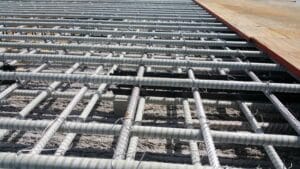
Made from glass fiber reinforced polymer (GFRP), Mateenbar60™ is 100% corrosion-free. It doesn’t rust. It doesn’t swell or spall inside concrete. It doesn’t break down in saltwater, humidity, or coastal environments.
And because it lasts longer, it reduces lifecycle costs dramatically, which is a growing priority for government-funded projects.
As we recently highlighted in our corrosion-focused blog, rust is predictable, expensive, and avoidable. The ASFPM conversations confirmed that more infrastructure professionals are ready to stop accepting corrosion as a given.
Built for Flood Zones. Backed by Real-World Projects.
The need for durable, long-term solutions was front and center. Engineers told us they’re tired of short-term fixes.
They’re looking for non-corrosive, structurally sound materials that can handle the pressures of flood mitigation without recurring maintenance or premature failure. Mateenbar60™ is already being used in:
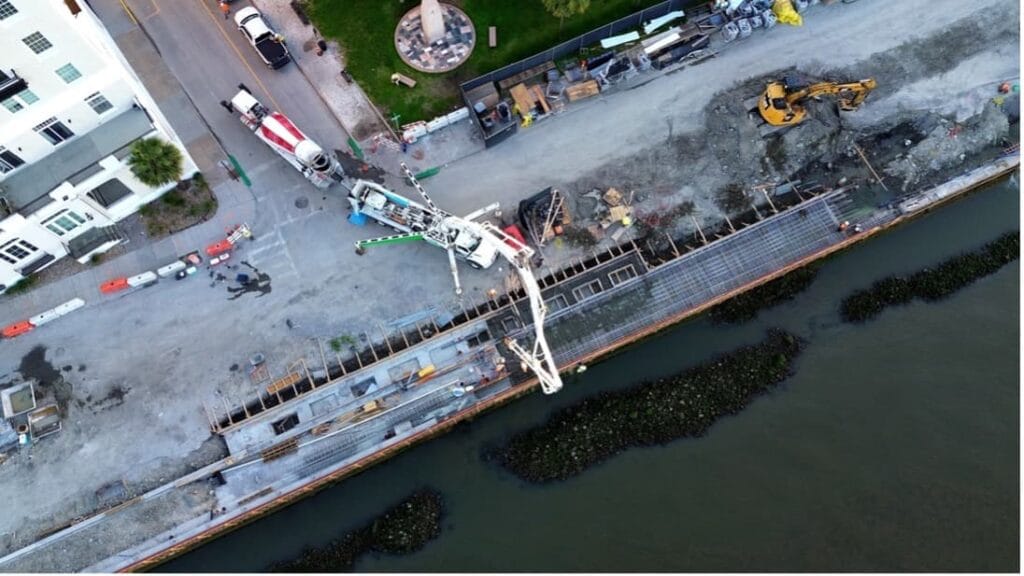
- Seawalls (i.e., Low Battery Seawall in Charleston, South Carolina)
- Bridges (i.e., Harker’s Island and Liberty Bridge)
- Historic preservation zones
- Saltwater and surge-prone environments
Every one of these applications requires performance, longevity, and the ability to stand up to environmental extremes. Steel can’t do it, but Mateenbar60™ can.
The Low Battery Seawall Project:
Proudly Made in the USA and Fully BABA-Compliant
Another major takeaway from ASFPM 2025: federal project leaders and local agencies are actively looking for Build America, Buy America (BABA)–compliant products.
With more funding tied to BABA requirements, sourcing compliant materials isn’t just preferred, it’s essential. Mateenbar60™ checks every box:
- Manufactured in the United States
- Fully BABA-compliant
- DOT-approved in several states
- Meets ASTM, ACI, and AASHTO standards
For cities, DOTs, and design engineers navigating these compliance standards, Mateenbar60™ offers a domestic, ready-to-deploy solution that’s already trusted nationwide.
The New Focus: Lifecycle Cost and Long-Term Resilience
One of the most refreshing parts of the conversations we had was hearing engineers talk not just about upfront costs, but about true lifecycle value.
With traditional steel, the math is simple but painful: corrosion leads to cracking, cracking leads to structural failure, and structural failure leads to massive repair or replacement costs. Every flood accelerates this cycle.
With Mateenbar60™, you get a material that never corrodes, which means:
- Less concrete damage
- Fewer repair cycles
- Lower inspection and maintenance costs
- More resilient infrastructure over time
When cities and agencies are building for the next 30, 50, or even 75 years, these savings are impossible to ignore.
The Time for Corrosion-Free Design Is Now
The ASFPM conference confirmed what we already knew: flood mitigation isn’t just about where water goes, it’s about how infrastructure holds up when water stays.
For engineers, planners, and policymakers trying to meet the challenge of rising seas, stronger storms, and stricter funding requirements, Mateenbar60™ offers a smarter alternative to steel:
- Stronger than rust
- Built for flood zones
- Made in America
- Proven in the field
Across the concrete industry, we’ve seen fiberglass reinforcement being widely adopted as a proven alternative to steel.
A key example of this—and a notable topic at the Conference—was the recent update to ASCE 24-24 ‘Flood Resistant Design and Construction Standards,’ which now permits the use of GFRP reinforcing bars in these critical infrastructure projects.
Let’s Keep the Conversation Going
We want to thank everyone who visited the Mateenbar® booth and shared their local challenges and national ambitions.
If you’re designing a seawall, managing a levee system, or working to preserve historic flood-zone infrastructure, we’d love to help.
Reach out to our Engineering or Sales team and take some time to explore our structural projects successfully deployed right here in the USA and globally.
With over 30 Years of strength, purpose, and sustainable innovation, discover why Mateenbar® reinforces what matters most. The future of flood mitigation doesn’t rust. Let’s build it together – with Mateenbar®.